


In the previous article we saw why rents are running at three times the rate of inflation. What remains is the second half of the question: why every pay rise ends up in prices instead of being absorbed. The answer is a number that is rarely discussed, and it is among the worst in the Greek economy.
Labour productivity is the output produced per person employed, in constant prices. It does not measure how hard someone works — it measures how much value their hour produces, given the equipment, the organisation and the size of the firm they work in.
It is the measure that determines whether a pay rise is inflationary or not. If wages rise 5% and productivity rises 5%, unit cost stays the same and prices do not need to move.
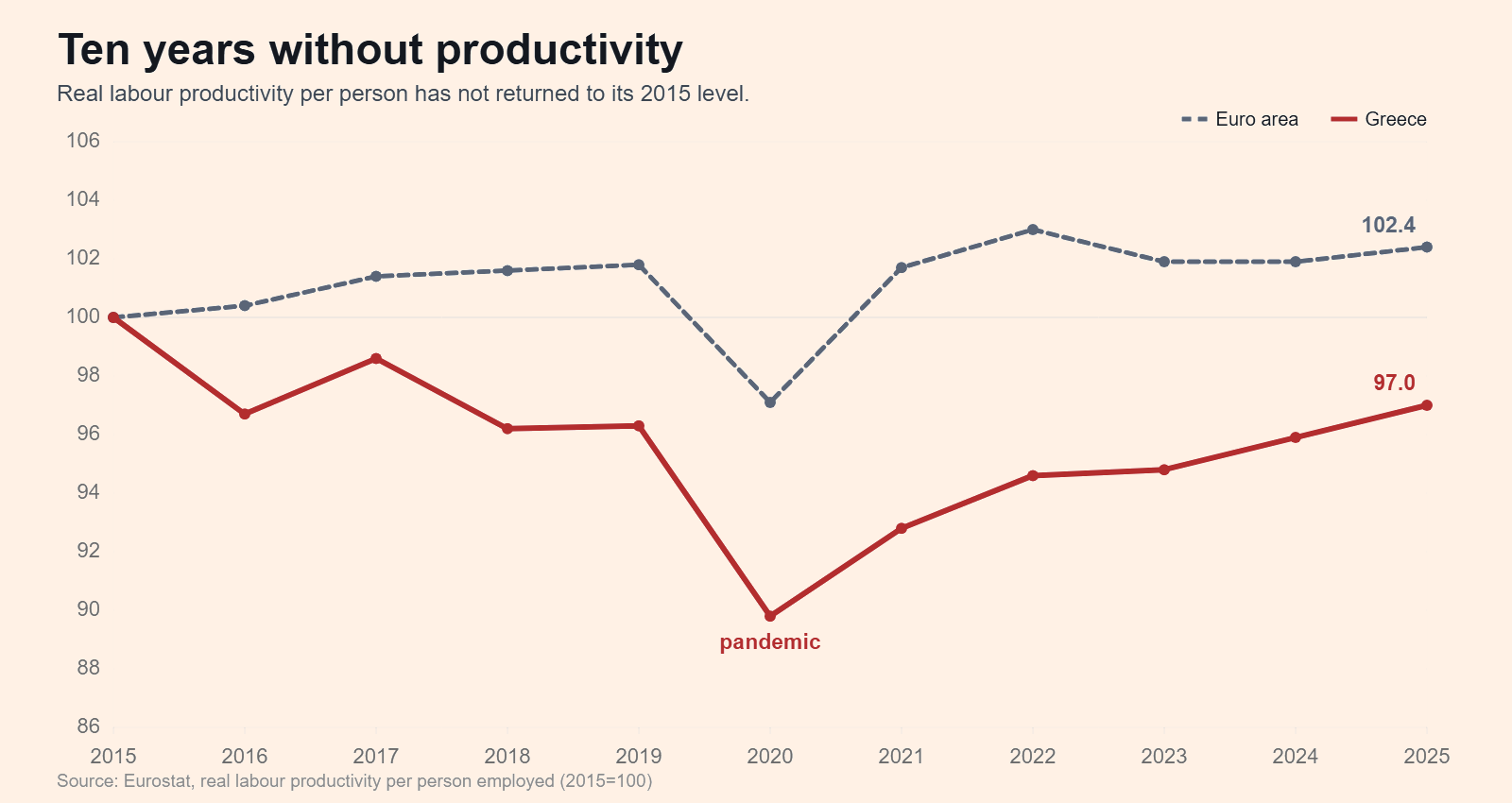
The Eurostat index, with 2015 as its base, puts Greek productivity at 97.0 in 2025. Ten years later, the economy produces less per person employed than it did in 2015.
The euro area over the same period went from 100 to 102,4. The gap is five points, and it is not down to the pandemic — the 2020 dip to 89.8 was largely recovered. It is down to Greek productivity already being on a downward path before it.
This is where the circle closes with the third article of the previous series. Unit labour cost is, by definition, the wage divided by productivity. When the numerator rises and the denominator falls, the ratio takes off.
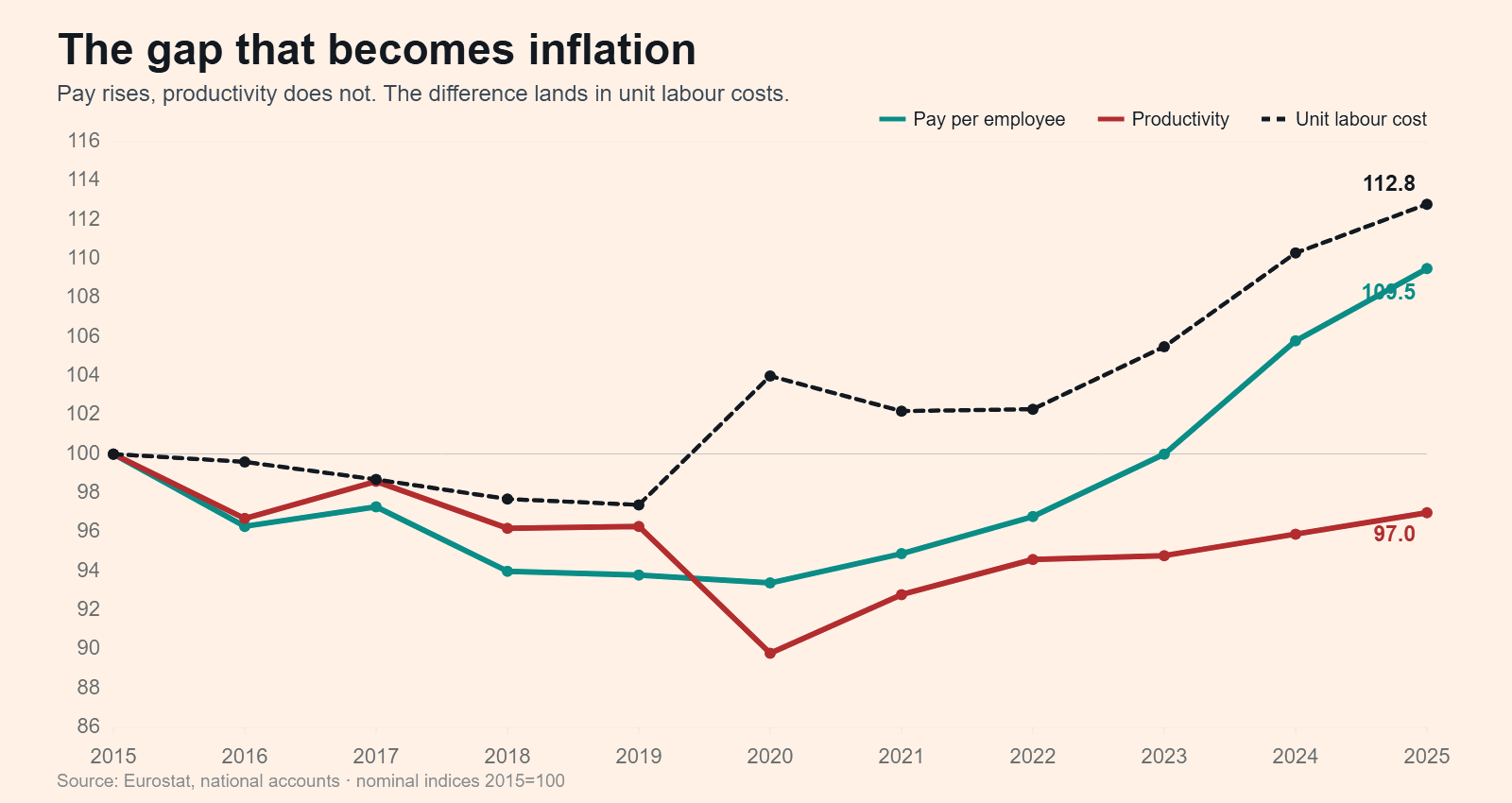
The numbers tie together: pay 109,5, productivity 97,0, and their ratio gives 112,9 — exactly what Eurostat’s independent unit labour cost index shows, 112.8.
The key point is that unit cost rose more than wages. This is not about workers who got a lot — nominal pay rose just 9.5% in ten years, meaning it lost ground to inflation. It is about an economy that produces less per person.
Productivity does not depend on the worker’s effort but on what surrounds them: how much capital per job, how large the firms are, how modern the technology, how effective the organisation.
In Greece, the new jobs created in recent years have mainly been in low-value-added sectors — tourism, hospitality and retail. They add employment, not productivity. And because the index is an average, every new low-productivity job pulls it down.
That there is no easy way out. As long as productivity stays flat, every pay rise has only two destinations: prices or margins. The third article of the previous series showed that since 2024 it goes into prices.
And this is why core inflation sits at 3% while the euro area is at 2%. It is not a mystery — it is arithmetic.
Sources: Eurostat, national accounts — real labour productivity per person employed, compensation of employees, employment and unit labour cost, 2015–2025. TechAnalysisNews calculations. The data and correlations do not constitute investment advice.

Certified Technical Analyst (MSTA) and financial/sports writer with expertise in capital markets, trading systems and trading strategies.
Graduate of the Department of Statistics of the London School of Economics and Finance of ALBA Business School.


