


One side says wages are rising at rates not seen for decades. The other says people cannot make it to the end of the month. Both are right, and the data show why. The previous article concluded that inflation had become domestic; here we examine who paid for it and who received it.
The Consumer Price Index is not suitable for this task because it also includes imported goods that are not produced here. The appropriate measure is the GDP deflator: the prices of what the Greek economy produces.
Its advantage is that it can be decomposed in accounting terms. The value of output is divided into three parts: labour compensation, operating surplus, and taxes less subsidies. Every percentage point of inflation can therefore be attributed to one of them. This does not show who is responsible; it shows where the increase ended up.
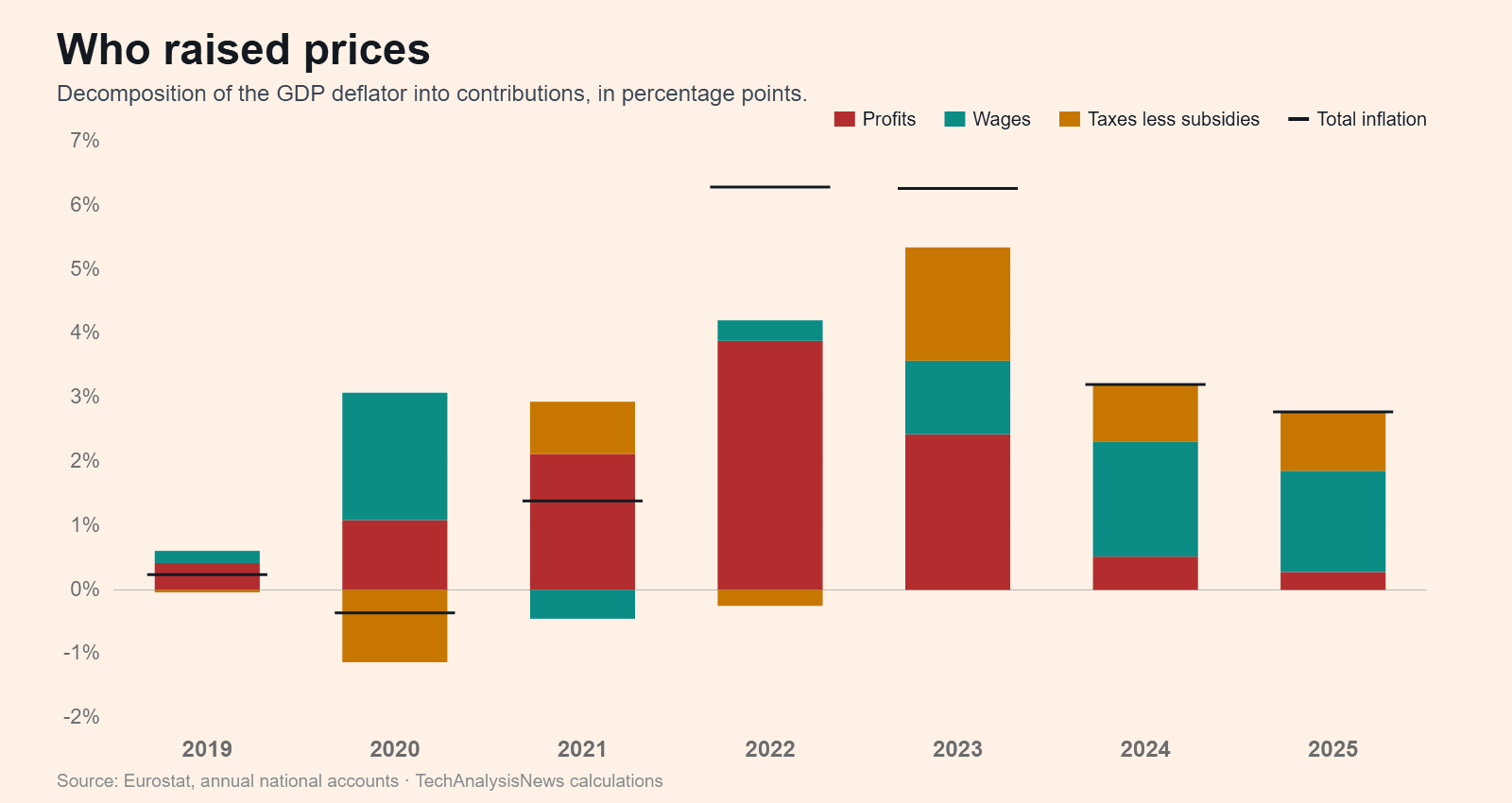
Prices of domestic output rose by 6.3%. Of these, 3.9 points came from profits and only 0.3 came from wages. More than 60% of the increase went to operating surplus.
In the same year, unit labour costs were virtually unchanged. Businesses were therefore not simply passing on higher wage costs—there were none. They passed on imported energy costs and widened their margins at the same time.
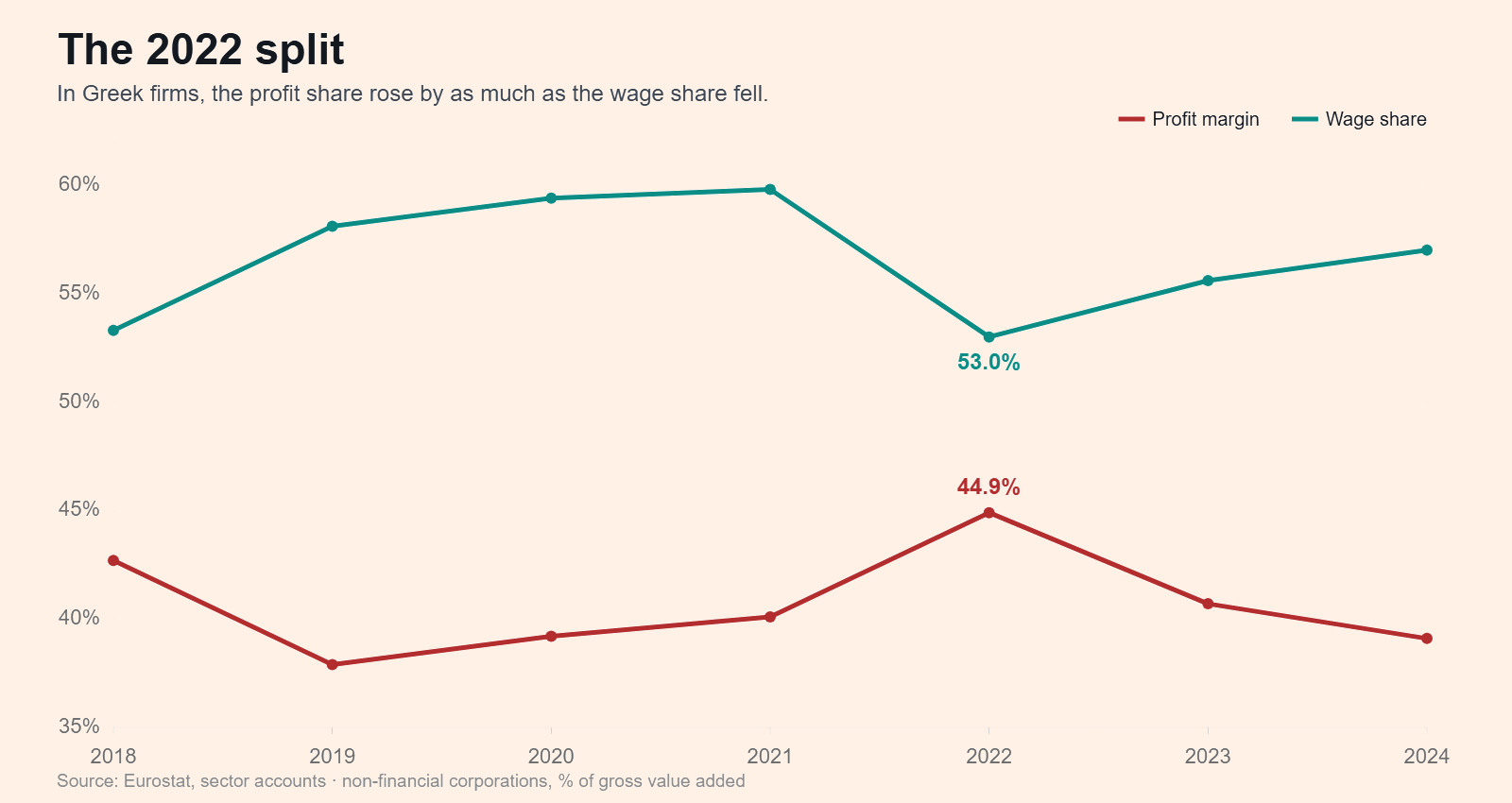
The same pattern appears from a completely different perspective. In Greek non-financial corporations, the profit margin rose from 40.1% in 2021 to 44.9% in 2022, while the wage share fell from 59.8% to 53.0%. Almost seven percentage points shifted from one side to the other in a single year.
This measure is cleaner than the economy-wide operating surplus because it excludes the self-employed, who account for one quarter of workers in Greece and whose income is remuneration for work rather than corporate profit.
The picture changes radically. In 2024 inflation was 3.2%, with wages contributing 1.8 percentage points versus 0.5 from profits. The same occurred in 2025: 1.6 versus 0.3. Corporate profit margins fell to 39.1%, below their 2021 level.
In other words, the inflation that remains today is wage-driven—not because wages are rising excessively, but because they are increasing faster than productivity while profits have stopped expanding their share.
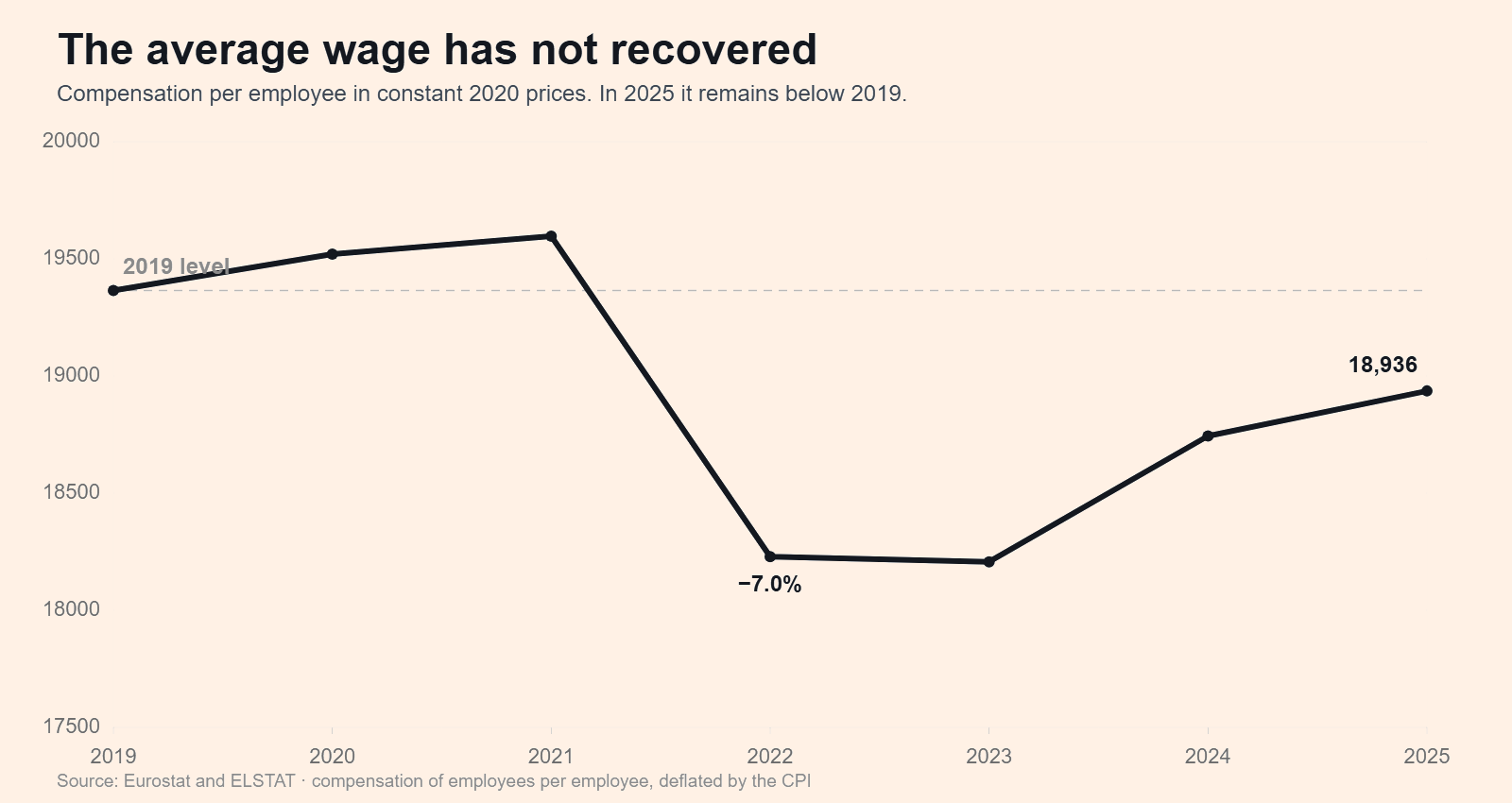
This is where the contradiction is explained. Real compensation per employee collapsed by 7.0% in 2022, remained stagnant in 2023 and began recovering in 2024. Yet in 2025 they remain 2.2% below the 2019 level.
At the same time, the number of employees increased from 3.48 million to 3.93 million—almost half a million new jobs. The wage index measures hourly pay in a fixed sample of firms and shows an increase; the national accounts measure the average across all workers and show a decline. When large numbers of lower-paid jobs are added, the average falls even if every existing wage rises.
Both sides of the public debate are therefore telling the truth. They are simply measuring different things.
The sequence is clear: an external shock in 2022 that became an opportunity to widen margins, a delayed wage recovery that is feeding today’s inflation, and an average worker who has not returned to the point where they started.
Three caveats. Corporate margin data extend only to 2024. The accounting decomposition shows where the increase ended up, not who caused it—part of the 2022 profits may reflect the pass-through of imported costs that do not appear in domestic measures. And 2019 was a year of unusually low margins, so comparison with it makes today’s picture look more favourable.
Sources: Eurostat, annual national accounts and institutional sector accounts; ELSTAT, Consumer Price Index. TechAnalysisNews calculations. The data and correlations do not constitute investment advice.

Certified Technical Analyst (MSTA) and financial/sports writer with expertise in capital markets, trading systems and trading strategies.
Graduate of the Department of Statistics of the London School of Economics and Finance of ALBA Business School.


