


The previous series of three articles ended with one conclusion and one question. The conclusion was that inflation in Greece has become domestic: core inflation has sat at 3% for two years and services are running ahead of goods. The question was which services. Eurostat data gives an answer that is hard to ignore.
From January 2019 to April 2021, the harmonised index of actual rentals for housing in Greece recorded exactly 0.0% in every single one of those 28 months. Not close to zero — zero, without a decimal.
Over the same period headline inflation swung from +1.1% to −2.4%. Rents did not move.
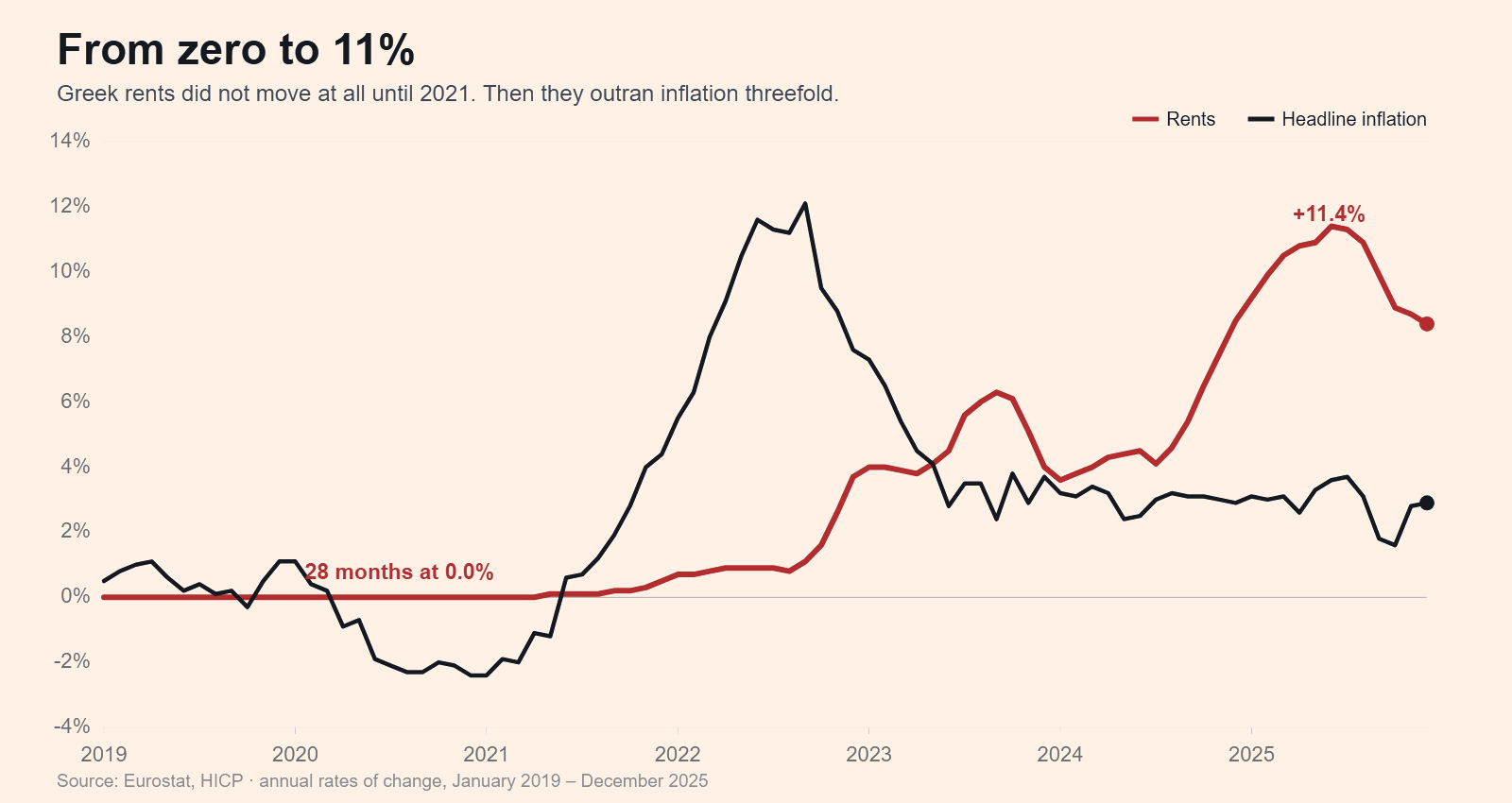
The move starts in mid-2021 and does not stop. In 2023 rents pass 4%, in 2024 they approach 5%, and in September 2025 they reach +11.4% — at a time when headline inflation is below 4%. By December they ease to 8.4%, still three times the headline rate.
The chart also shows something less obvious: the two lines take turns. First headline inflation runs, in 2022. Rents peak two years later. They are the last category to adjust — and that is why they keep running when everything else has calmed down.
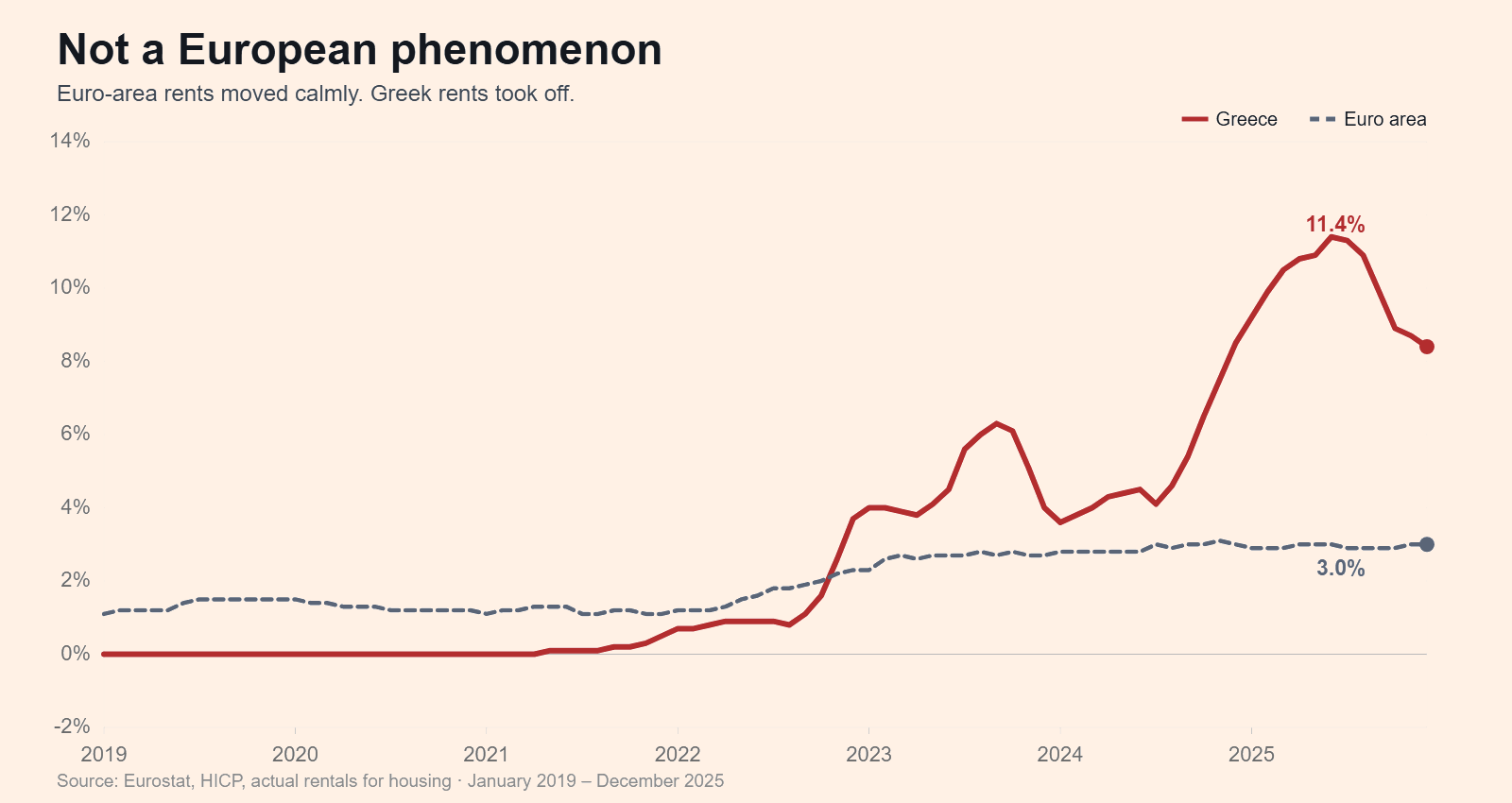
In the euro area rents moved from 1.2% to 3.0% over seven years — a mild, smooth rise with no jumps. The same international conditions, the same interest rates, the same energy crisis.
The Greek difference is not explained by anything imported. It is explained by housing supply, by short-term rentals, by investment demand, and by a market that was frozen for years and suddenly thawed.
The question of why has an answer, and it lies in purchase prices. The Bank of Greece apartment price index bottomed out in 2017 and turned around in 2018. In Athens the increase was already +10.6% in 2019 — the year the rent index was recording exactly zero.
The Athens index has doubled: from 56.2 points in 2017 to 113.4 in 2025.
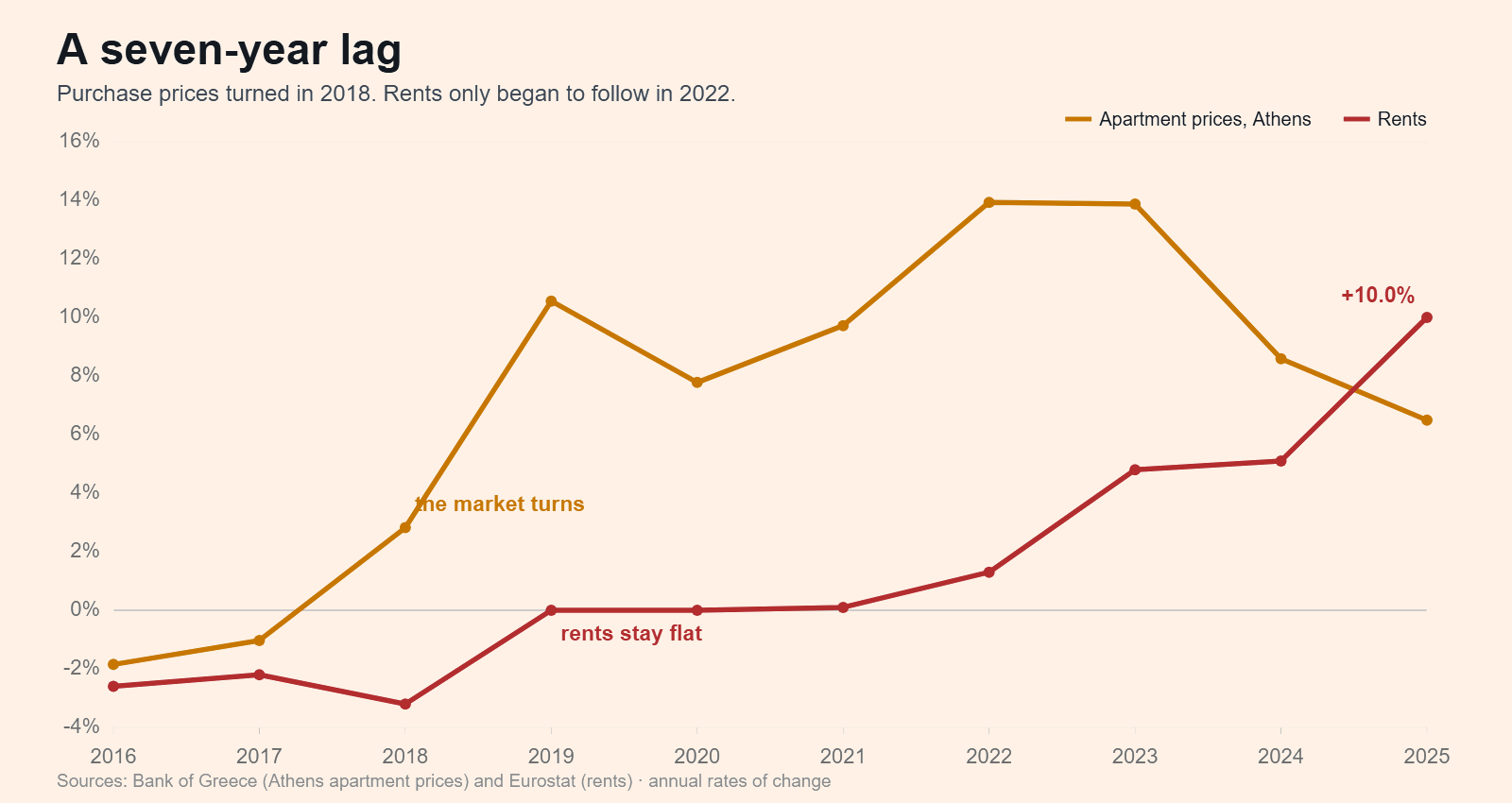
The lag is explained by the nature of a lease. A tenancy locks the price in for years; the market does not. While the market rose, existing contracts kept rents frozen. As they expire one by one, they unlock at the new price — and the index is recording today a rise that happened in the market years ago.
In 2025 the reversal is complete: purchase prices have slowed to 6.5% in Athens, while rents are running at 10.0%. For the first time in seven years, rents are rising faster than prices.
The consequence is uncomfortable: because the adjustment happens with such a long delay, the rise in rents still has further to go — even if purchase prices stop rising today.
This needs care, and it is the most important point in the article. The index measures existing tenancies, not listings. The sample mostly includes tenants renewing, not someone looking for a home today.
The 28 zeros confirm it: no real market stays completely still for two and a half years. What stayed still was the contracts, not the prices. So 11.4% is not an exaggeration — it is an underestimate of what a new tenant experiences.
Housing carries one of the largest weights in the consumer basket. When such a category runs at three times the average, it drags the whole services index with it — and explains why core inflation does not fall below 3%.
And unlike energy, rents do not fall on their own. An energy shock passes within twelve months; a tenancy locks in for three years. What enters housing costs, stays.
Sources: Eurostat, Harmonised Index of Consumer Prices, actual rentals for housing (CP041) and the all-items index, January 2019 – December 2025. The data and correlations do not constitute investment advice.

Certified Technical Analyst (MSTA) and financial/sports writer with expertise in capital markets, trading systems and trading strategies.
Graduate of the Department of Statistics of the London School of Economics and Finance of ALBA Business School.


